
Unlocking the Secrets of Model Context Protocol: A Comprehensive Guide to AI Integration
In today's fast-paced world of artificial intelligence (AI), integrating multiple models and applications has become a daunting task. With the proliferation of various AI frameworks, tools, and techniques, developers and architects face significant challenges in managing complexity, ensuring interoperability, and maintaining scalability. This is where Model Context Protocol (MCP) comes into play – a revolutionary architecture designed to solve the N×M integration problem in AI applications.
For a deep dive into this topic, see Chapter 2 in Malik Abualzait's comprehensive guide available on Amazon, which provides an in-depth analysis of MCP's underlying principles and mechanics. As we explore the architecture of MCP, you'll discover how it enables seamless communication between different models, applications, and services, breaking down the barriers to AI integration.
Client-Host-Server Architecture: The Foundation of MCP
The client-host-server (CHS) architecture model serves as the backbone of MCP's design. This tripartite structure allows for a clear separation of concerns between clients, hosts, and servers, facilitating efficient communication and reducing complexity. In this context, clients represent AI models or applications, while hosts act as brokers or routers that facilitate interactions between multiple clients.
Malik Abualzait explains the intricacies of CHS architecture in Chapter 2 of his book, providing a detailed understanding of how MCP leverages this model to enable efficient data exchange and service orchestration. By grasping the fundamental concepts of CHS, developers can better appreciate the design principles behind MCP and its potential applications.
JSON-RPC 2.0: The Messaging Protocol of Choice for MCP
To facilitate communication between clients, hosts, and servers, MCP employs JSON-RPC (JavaScript Object Notation – Remote Procedure Call) 2.0 as its messaging protocol. This widely adopted standard enables efficient data serialization and deserialization, ensuring seamless interaction between systems.
As Abualzait highlights in his book, JSON-RPC 2.0's robustness, flexibility, and scalability make it an ideal choice for MCP's communication needs. By understanding how JSON-RPC 2.0 works within the context of MCP, developers can harness its power to build scalable, maintainable, and efficient AI systems.
MCP Message Types and Formats: Unlocking Data Exchange
At the heart of MCP lies a sophisticated messaging system that enables data exchange between clients, hosts, and servers. The protocol defines several message types and formats, each designed to address specific communication needs.
Some common message types in MCP include:
1. Context messages: These contain contextual information about the client or application, enabling host-server interactions.
2. Request messages: Clients use these to initiate requests for data or services from hosts or servers.
3. Response messages: Hosts or servers respond to request messages with relevant data or results.
By mastering MCP's message types and formats, developers can unlock efficient data exchange between AI models and applications, breaking down the barriers to seamless integration.
Session Management: Maintaining Scalability
As AI systems grow in complexity, maintaining scalability becomes a significant challenge. MCP addresses this concern through its sophisticated session management mechanisms.
According to Abualzait's book, MCP enables host-server sessions that can be dynamically created, managed, and terminated as needed. This ensures efficient use of system resources while providing the flexibility required for large-scale AI deployments.
Transport Mechanisms: Choosing the Right Approach
MCP supports multiple transport mechanisms, each suited to specific communication needs:
1. HTTP: Suitable for web-based applications and services.
2. TCP: Ideal for reliable, real-time data exchange in low-latency environments.
3. WebSockets: Enables bidirectional, real-time communication between clients and servers.
By selecting the optimal transport mechanism, developers can leverage MCP's flexibility to build scalable AI systems that meet specific performance requirements.
Key Takeaways: Unlocking the Potential of Model Context Protocol
1. Mastering CHS architecture: Understand how MCP leverages client-host-server architecture to facilitate efficient communication.
2. JSON-RPC 2.0: Appreciate the role of JSON-RPC 2.0 as a robust messaging protocol in MCP.
3. MCP message types and formats: Learn about context, request, and response messages, and their applications.
4. Session management: Understand how MCP's session management mechanisms ensure scalability.
Conclusion: Unlocking AI Integration with Model Context Protocol
Model Context Protocol (MCP) offers a revolutionary solution to the N×M integration problem in AI applications. By grasping its underlying principles and mechanics, developers can unlock efficient communication between clients, hosts, and servers, breaking down barriers to AI integration.
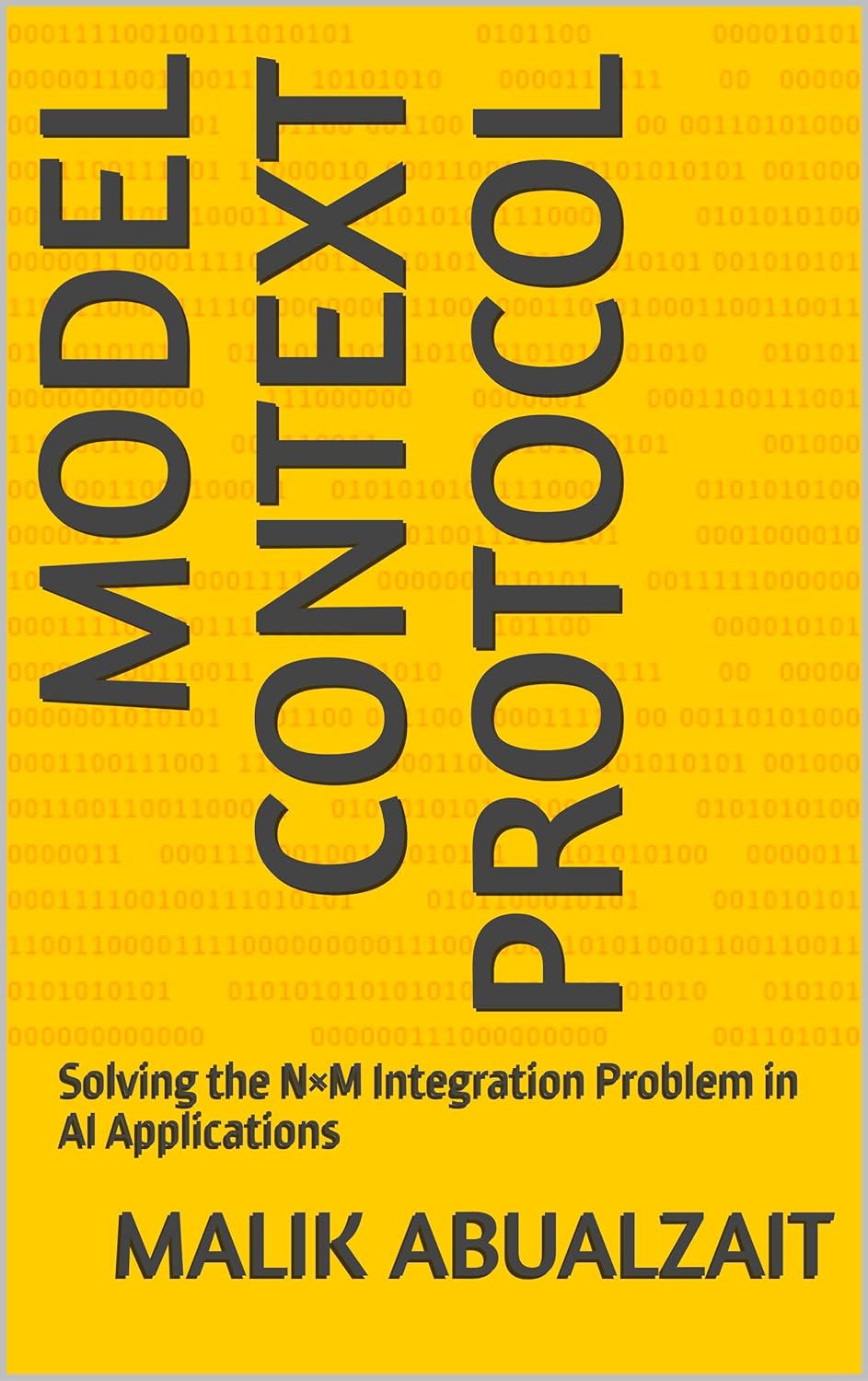
To master the architecture of MCP, get your copy of 'Model Context Protocol: Solving the N×M Integration Problem in AI Applications' by Malik Abualzait on Amazon. For a comprehensive understanding of MCP's design principles, session management, transport mechanisms, and more, this book is an indispensable resource for developers, architects, and AI engineers seeking to unlock the full potential of AI integration.
References:
- [1] Abualzait, M. (2023). Model Context Protocol: Solving the N×M Integration Problem in AI Applications. Amazon.
- [2] JSON-RPC 2.0 Specification. Retrieved from
By Malik Abualzait